Recipes

Candy Cane Cookies

This blog post isn’t for you.

Don’t get me wrong, I would love you to love these cookies.

But this really isn’t about you. It’s about my grandma, Evelyn, and the most sought-after, fought-over treat she makes.
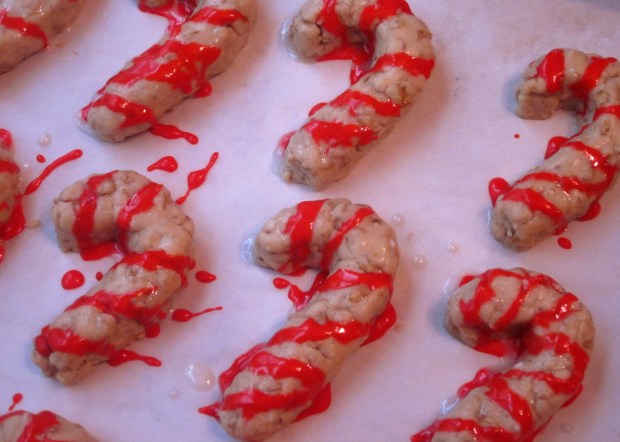
IMG_2446

Two weeks ago, Evelyn celebrated her 90th birthday. I was so happy to be back in Nebraska celebrating. Evelyn is a quintessential farm wife who grew up in Nebraska during the Depression. Well into her 60s, she was still driving farm trucks and helping out on the farm (Update: my dad informs me she was “pushing 80” when she finally gave up driving trucks, and noted that she still brings out supper during harvest sometimes). To this day, you’ll still see her overexerting herself in her garden and flowerbeds.

This slideshow requires JavaScript.

If there’s such a thing as a genetic sweet tooth, there’s no doubt I inherited it from her. The cookie jar and candy dish were never empty. She’d often say, “I think we should have dessert first, so we’re sure to have room.”

Every Christmas, Grandma made plates of holiday cookies and candies for family and friends. Of all the treats you might find on that plate — peanut butter blossoms, divinity, sugar cookies, fudge — the first to disappear on our plates was always the candy cane cookies. There were never enough. We’d beg her to only make candy cane cookies and cut out the rest, or at least make a double-batch. I don’t think we’ve ever succeeded.

On Christmas Eve, we had to be the first ones to our grandparents’ house, not so that we could inspect the presents under the tree (although my brother did plenty of that), but in hopes of sneaking an extra candy cane cookie. If she delivered cookie trays to our house or wanted us to come pick them up, I angled to be part of the transaction. I’m surprised these cookies have never used for outright bribery or gambling.

Grandma thinks she’s had this recipe at least 50 years. The first time I asked for the recipe, I had to call and ask her what a “slow oven” was (around 300 degrees).

Just yesterday, she confessed to me that she likes making the cookies, but doesn’t like frosting them. “Do you want to come over and frost these for me?” she asked. Note to family members within driving distance: missed opportunity!
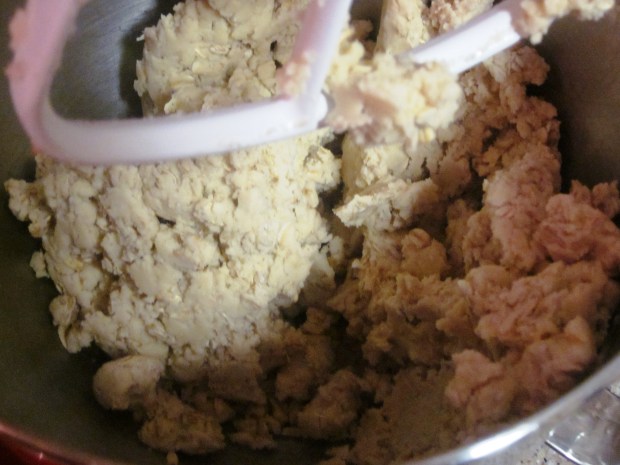
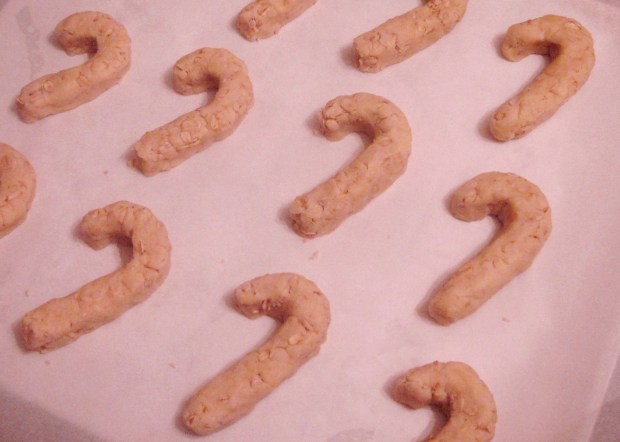
Dough

IMG_2443

The irony is that these cookies are the antithesis of a Christmas cookie: they aren’t buttery, gooey, indulgent, glittery, or magazine-photo-worthy. They’re dry and rather plain. Outsiders don’t get it. An in-law politely said, “I’m not really fond of them.”

I’m more than okay with that. These cookies are nothing special, and that’s precisely the point.

Besides, that means more cookies for me.
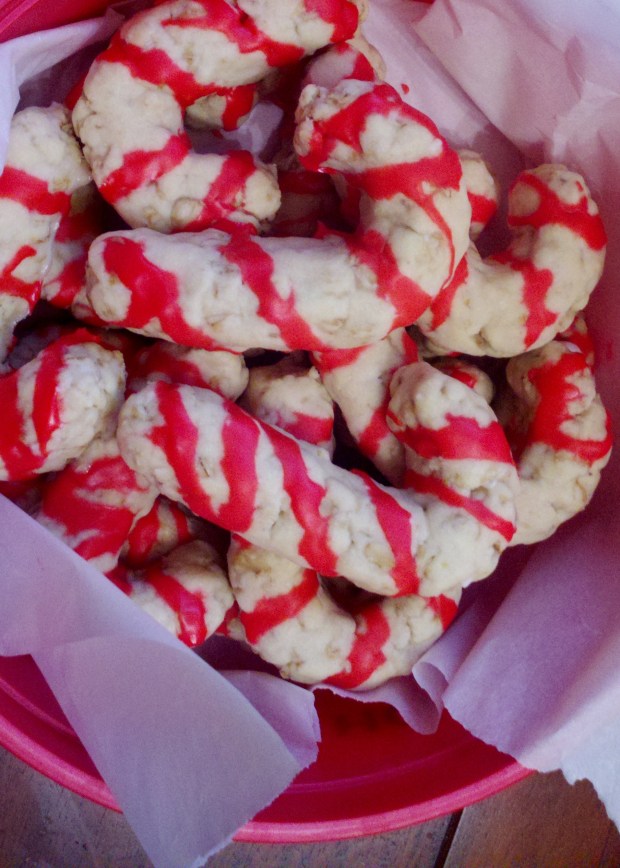
2012-12-16_14-44-33_433

Candy Cane Cookies

Yield: 18-24 cookies

1 c butter, softened

2 tsp. vanilla

1/2 c powdered sugar

2 Tbs. water

2 1/2 c flour

1/2 tsp. salt

1 1/2 c oats

For powdered sugar glaze:

1 1/4 c (or more) powdered sugar, sifted

2-3 Tbs. (or more) milk

Red food coloring

Preheat oven to 300 degrees. Cream butter and vanilla. Add powdered sugar; blend well. Add water, flour, salt and oats. Mix well. Shape into canes and place on ungreased cookie sheets. Bake at 300 degrees for 20-25 minutes, until set and lightly toasted. Transfer to a wire rack to cool completely.

Combine 1 cup powdered sugar and milk to make a glaze to desired consistency. (The thinner your glaze, the more it will be absorbed into the cookie.) Dip cookies in glaze and place on waxed paper to set.

With the remainder of the glaze, add red food coloring and a few more tablespoons powdered sugar to make a thick glaze. Spoon glaze into a Ziploc bag, snip the corner, and pipe stripes onto the cookies.

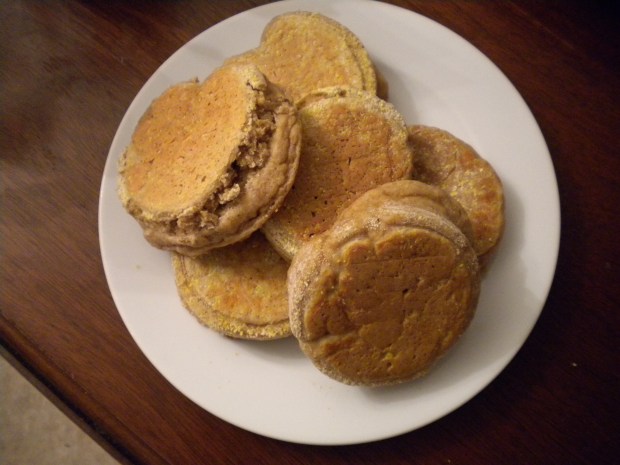
100% Whole Wheat English Muffins

RHRW Note: Welcome my first guest blogger, Danielle. She is an English professor and a dear long-distance friend. We agree with her self-assessment about her frugality, but love her anyway.

I am, shall we say, frugal. Some — my husband, good friends, acquaintances forced to dine out with me — would call me cheap. I am, however, willing to pay for good, high-quality food. What will remain an unnamed brand of English muffins, however, does not count as high-quality food. So when my local grocery store raised the price of English muffins to $4.50/package, I decided to make my own, something that I’d never made before.

Even though I’d never made English muffins, I am not a novice baker. Much like our resident blogger (see Knotted Dinner Rolls), I spent many years in 4-H baking. I love to cook. I like to bake. The time requirements often keep me from pursuing it more often than I do. On a rainy Sunday afternoon with some time on my hands while I waited for students’ papers to come in during finals week, I experimented with the English muffin.

Whole Wheat English Muffins

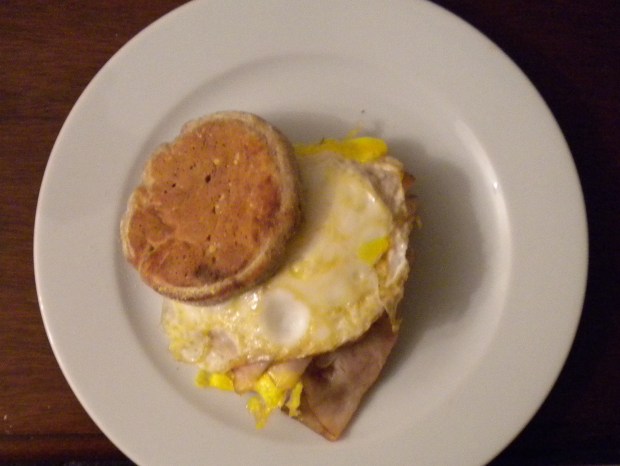
These came out well. They’re approximately the same size as store-bought muffins. They had the requisite “nooks and crannies” I look for, they were 100% whole wheat, and there were no preservatives, a win all around.  Though there is a bit of sugar in here, honey or agave syrup would work well too.

DSCN0316

100% Whole Wheat English Muffins

Adapted from Food Network

Makes 9 muffins

1 cup warm skim milk

1 Tb sugar

1 tsp. salt

1 Tb canola oil

1 envelope active dry yeast

1/8 tsp. sugar

1/3 cup lukewarm water

1 cup whole wheat flour

1 cup white whole wheat flour

Special equipment: 3-inch metal baking rings. You can purchase specialty baking rings at most stores that sell cooking equipment. I used the rings of quart jars used for canning. Tuna cans with the top and bottom cut out would work too, or even rings made out of aluminum foil.

In a bowl, combine warm milk, sugar, salt, and oil. Stir to dissolve salt and sugar.

In a separate small bowl, combine yeast, sugar, and lukewarm water. Stir to dissolve yeast. Mix yeast mixture with milk mixture.

Put flours in a medium to large bowl, and add the liquid mixture. Mix with a wooden spoon until the flour and milk mixture is thoroughly combined. Let rest for 30 minutes in a warm place. The dough will be batter-like in its consistency and considerably stickier than any bread dough you’ve worked with before. It is not meant to be rolled or kneaded.

Preheat oven to 350 degrees. Heat nonstick pan or griddle on stove top on medium-low heat. Dust bottom of the pan with cornmeal. Coat metal rings with non-stick spray, dust with corn meal, and place in the pan.

Pour 1/4 to 1/2 cup batter in each ring. Cover pan with a lid or cookie sheet. Cook muffins for 7 minutes on each side. Author’s note:  I recommend cooking one muffin first to check the timing, then cook as many as your non-stick skillet will allow you to. I could cook 4 muffins at a time. If you have a griddle (and rings) that allow you to cook more, do so. It will speed up the process considerably.

Remove muffin from ring and place muffin a cooling rack placed over a cookie sheet. When all muffins are finished cooking on the stovetop, bake for 7 additional minutes to finish cooking through. Let cool completely.

Knotted Dinner Rolls

I’ve always had a reputation as a good cook and a better baker. I credit that to a childhood spent in 4-H.

4-H has evolved considerably over the past two decades, but even in the 1990s, it was about a lot more than baking, sewing, and livestock. My first public speaking competition was not in high school, but as an 8-year old in a 4-H contest. It’s where I learned about first aid, budgeting, meal planning, and more.

But, when it came town for county and state fairs? Well, those were still forums that showcased more “traditional” skills. Fairs are designed to showcase tangible products for a period of several days: livestock, clothes, vegetables from the garden, model rockets, entomology displays… and yes, baked goods.

I didn’t have a garden, and I didn’t learn how to can foods until I was an adult, but I could sew and bake with the best of them. Somewhere in an attic are the boxes of trophies and ribbons to prove it.

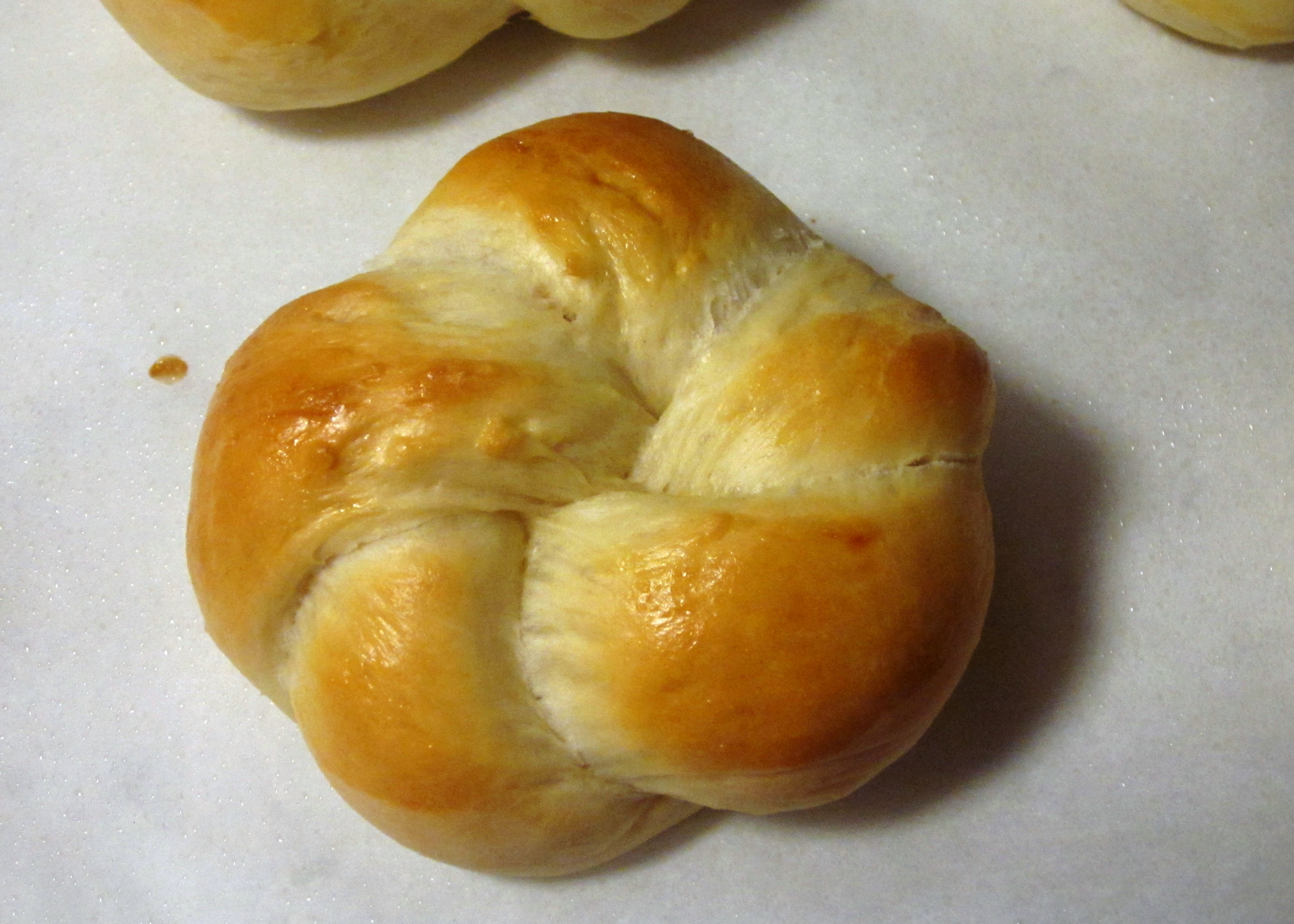
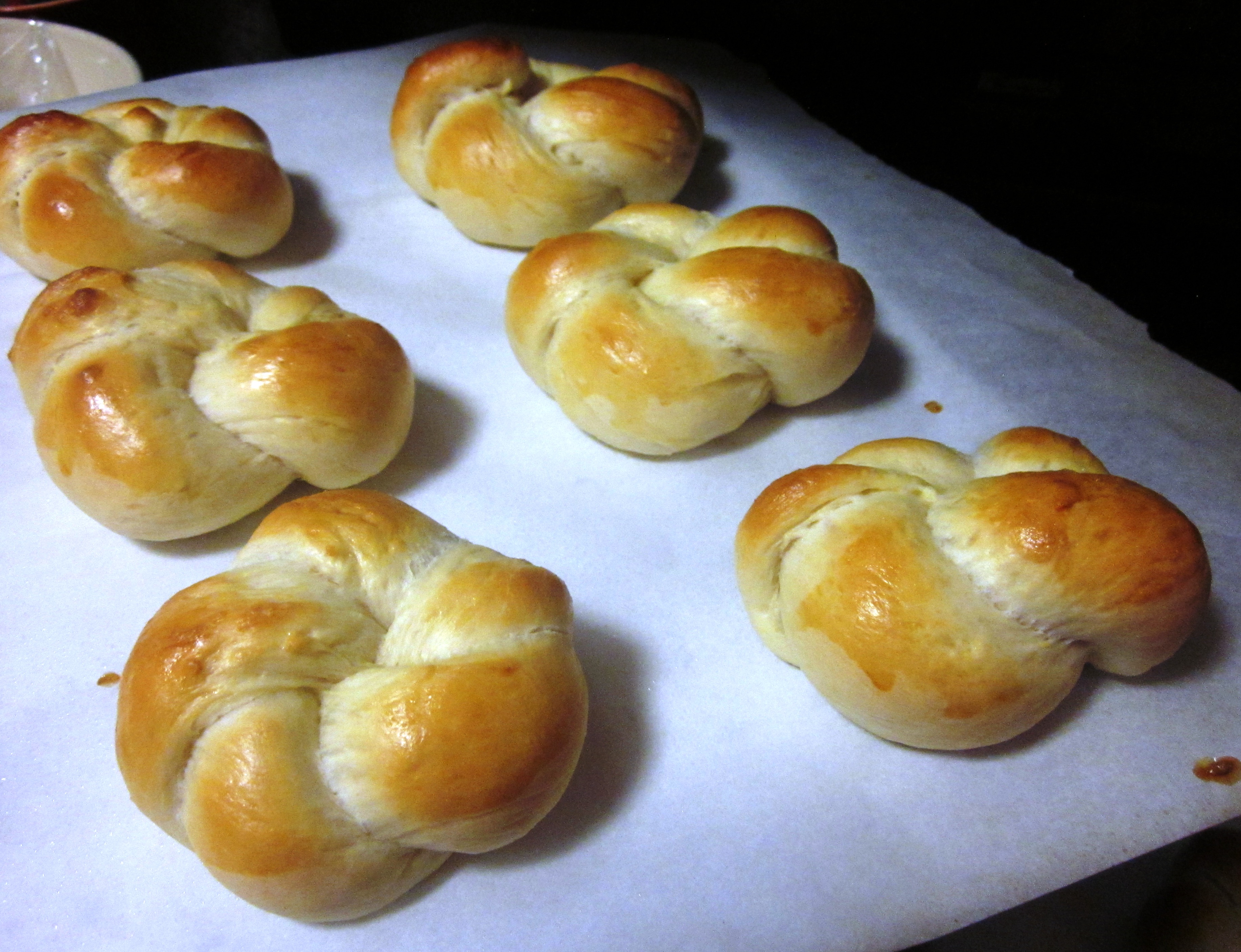
I wish I could say this recipe has been with me since those early 4-H days, but I actually came across it a year ago. Still, it’s exactly the kind of recipe I would have made . The knotted shape makes them look more difficult than they are, and the egg wash gives them a beautiful, golden color. These have purple ribbon written all over them, and they stole the show on my Thanksgiving table.

Measure your flour with a scale if you can; it’s much more accurate than trying to use measuring cups.

Knotted Dinner Rolls

From Fine Cooking, October/November 2011

Makes 18 rolls

1 1/2 cups whole milk; more as needed

1 packet (1/4 oz. or 2-1/4 tsp.) instant or active dry yeast

1/4 cup vegetable oil; more as needed

2 Tbs. unsalted butter

1/4 cup granulated sugar

1 lb. 7 oz. (5-1/4 cups) unbleached bread flour; more as needed

1 1/4 tsp. table salt or 2 tsp. kosher salt

1 large egg

For shaping:

Vegetable oil spray

1 large egg

1 Tbs. water

Poppy or sesame seeds for garnish (optional)

In a small saucepan, heat the milk until lukewarm (about 95°F). Remove from the heat and whisk in the yeast until it dissolves. Add oil and butter (the butter may not melt completely), and then whisk in sugar. Let rest until the yeast just begins to float to the surface, about 5 minutes.

In a stand mixer fitted with the paddle attachment (or in a large bowl), combine the flour, salt, and egg. Add the yeast mixture and mix on low speed (or with a large spoon) until a coarse ball of dough forms, about 1 minute. Let rest for 5 minutes.

Replace the paddle attachment with the dough hook and mix on medium-low speed (or knead by hand on a lightly oiled work surface) until the dough feels soft, supple, and pliable, about 3 minutes; it should feel tacky to the touch, but not sticky, and pull away from your finger when poked instead of sticking to it. If the dough is too sticky, add 1 Tbs. flour at a time, kneading to incorporate. If it’s stiff, knead in 1 Tbs. of milk at a time. Don’t overwork the dough.

Rub a little vegetable oil on a work surface to create an 8-inch circle and put the dough on this spot. Stretch and fold the dough over itself from all four sides to the center, crimping it where the folded ends meet, to form it into a tight, round ball.

Lightly oil a bowl twice the size of the dough. Put the dough seam side down in the bowl; tightly cover with plastic wrap. Let sit at room temperature until doubled in size, about 90 minutes.

Line two large baking sheets with parchment or nonstick baking liners and lightly mist them with cooking spray. Divide the dough into eighteen pieces (about 2-1/4 oz. each).

With your hands, roll one piece into a 12-inch-long rope. If the dough starts to stick, mist your work surface lightly with vegetable oil spray or wipe it with a damp towel. Don’t use flour.

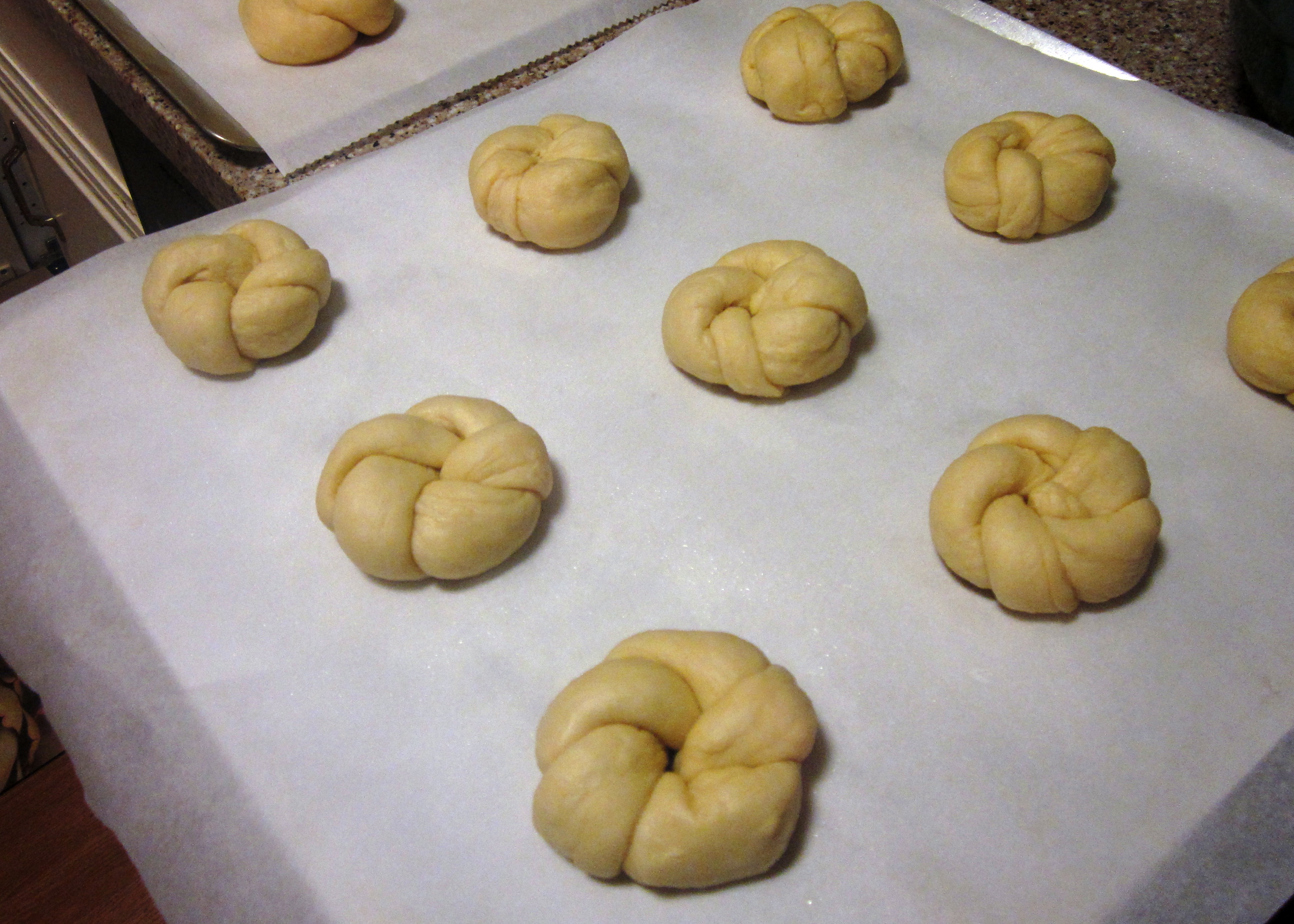
Wrap the dough around your fingers into a loose knot; there should be about 2 inches of dough free at each end. Wrap the left end of the dough up and over the loop. Wrap the right end down and under the loop. Lightly squeeze the two ends of dough together in the center to secure them.

Gently squeeze the whole piece of dough into a nice rounded shape. Put the roll, pretty side up, on a baking sheet. Repeat with the remaining dough. Mist the top of the rolls with vegetable oil spray and cover loosely with plastic wrap.

Let the rolls sit at room temperature for about 30 minutes. Position racks in the upper and lower thirds of the oven and preheat the oven to 400°F.

Thoroughly whisk the egg and water; brush all over each roll. If desired, sprinkle with poppy or sesame seeds.

While the oven heats, let the rolls continue to rise at room temperature, 20 to 40 minutes. They should be 1 1/2 to 2 times their original size before they go in the oven. (Once in the oven, they will rise about 20 percent more.)

Put the baking sheets in the oven and bake for 6 minutes. Rotate the sheets 180 degrees and swap their placement on the racks. Continue baking until the rolls turn rich golden-brown on top and develop some browning underneath, another 6 to 8 minutes. Let the rolls cool on the sheets or on a cooling rack for 15 minutes before serving.