Sauces & Condiments

Salted Caramel Sauce

I hate — HATE — making mistakes. Failure? Nope. Not happening.

I’m not perfect, but I *am* a perfectionist. (There’s a difference, right?) I love the idea of continuous improvement. I’m very self-critical, but I also seek out feedback constantly, whether it’s at work, at the gym (where I teach group fitness), or in the kitchen. It’s nice to know what I’m doing well — we all want and need positive feedback — but I’m much more interested in whats not working and how I can do better.

When cooking, I especially love trying dishes that involve a new skill, technique, or ingredient. I embrace the learning process, and I never expect anything to turn out perfectly the first time. Hopefully, it’s edible, and in the second batch, I’ll have ironed out any kinks.

At least, that’s the usual plan.

Salted Caramel Sauce

Enter: Salted caramel sauce. I’ve worked with boiling sugar before, including to make marshmallows, fudge, and other candy. I needed salted caramel sauce for a recipe, and it seemed like I could easily knock it out on a weeknight. No big deal.

Oh, but it was. I tried different pots of different size and material. I tried different temperatures. I tried using a candy thermometer and I tried winging it. I made thick black goo, crunchy brown brittle, crunchy golden brittle, and the most delicious chewy caramels ever (which I couldn’t even tell you how to replicate).

Four batches, four failures.

FOUR!?!? I never screw up FOUR times!

At this point, I was fuming, but it was late and I was out of both ingredients and patience. Ego bruised, I walked away.

Two weeks later, I was perusing the latest issue of Bon Appetit, and happened to notice that one of the recipes included a salted caramel sauce. I compared the ingredients and a special technique primer. What I learned is that many recipes for caramel, including the one I was using, are not forgiving; they require precise equipment, temperature and timing. One misstep, and you’ll either burn the sugar (see: thick black goo), or crystallize the sugar (see: brittle).

“For a smooth, anxiety-free caramel, every time,” BA recommends adding cream of tartar, which is acidic and stabilizes the sugar.

Sweet, salty victory.
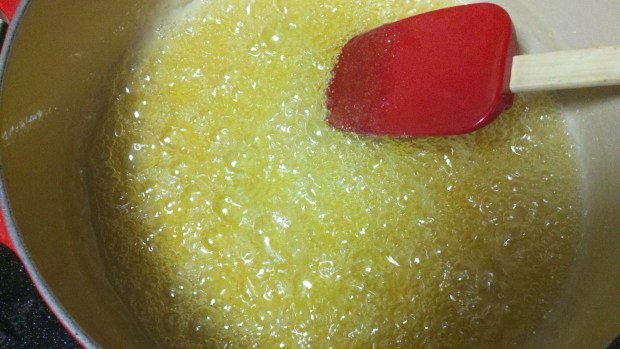
Once the sugar dissolves, put the spatula away until it begins to caramelize.
Once the sugar dissolves, put the spatula away until it begins to caramelize.

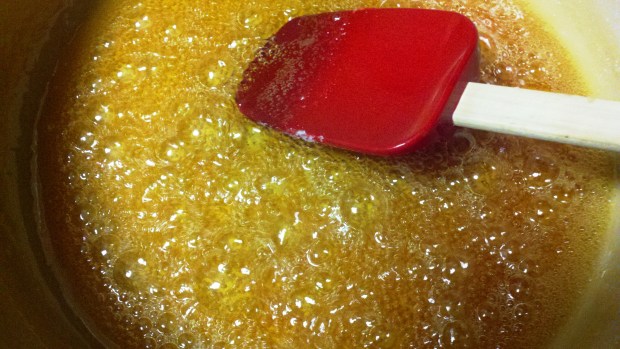
The mixture progresses from honey to amber very quickly. Watch it carefully.

The mixture progresses from honey to amber very quickly. Watch it carefully.

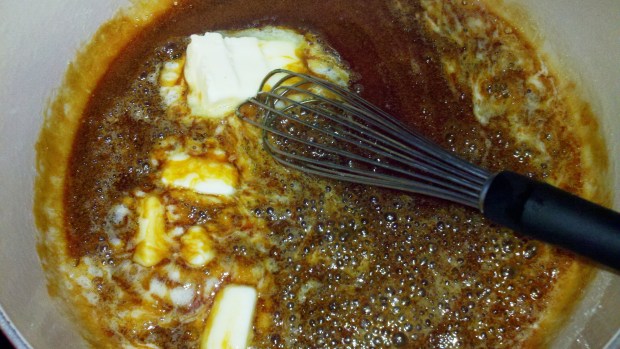
Turn off the heat and carefully stir in the butter. The mixture will get very bubbly.

Turn off the heat and carefully stir in the butter. The mixture will get very bubbly.

Salted Caramel Sauce

Adapted from Bon Appetit

Yield: about 1 1/4 cups

1 cup sugar

1/8 tsp cream of tartar

3 Tbs water

1/4 cup unsalted butter, cut into pieces

1/2 cup heavy cream

1 tsp kosher salt

Choose a heavy-bottomed saucepan with high sides, as the mixture will bubble up. Whisk together sugar, cream of tartar, and water. Bring to a boil over medium-high heat. As the mixture comes to a boil, the sugar will dissolve. Stir once with a heatproof spatula.

Keep watch as the mixture boils, but do not stir. Once you see it start to caramelize in spots, stir again to ensure even caramelization. When the mixture is the color of honey (about 10 minutes), lower the heat to medium-low, to give yourself more control. When the color reaches a deep amber color (about 5 minutes more), turn off the heat.

Note: cooking times can vary considerably. Stay close and judge with your eyes, not the clock.

Remove caramel from heat. Carefully whisk in butter (mixture will bubble vigorously), then whisk in cream and salt. Let cool slightly in pan, then pour into a heat-proof bowl or jar.
Charred Chili Barbecue Sauce

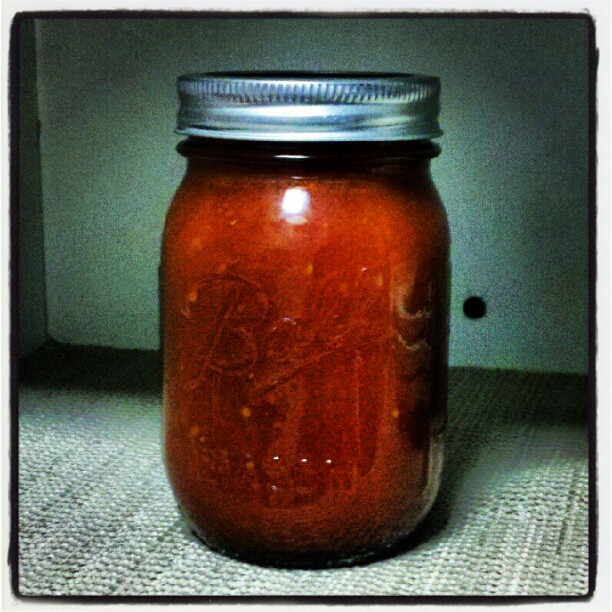
A jar of charred chili barbecue sauce

I finally had the chance to check out the Del Ray Farmers’ market this weekend, and came home with a large haul of locally-grown vegetables and fruit.

The corn turned out to be a dud, but the rest was great. I was most excited about the chili peppers. After the great luck I’d had canning corn salsa, I was hoping for a repeat performance. My canning book included what sounded like a delicious homemade barbecue sauce.

The sauce turned out perfectly; I soon found myself hovering over the pot, eating it by the spoonful.

The canning? Not so much. A few days after canning, I noticed that the jars were filled with bubbles. Uh oh.

A telltale sign of a canning project gone wrong is when the food starts to look carbonated (unless, of course, you’re making homemade sparkling wine or cider — but that’s for another blog). Canning is completely safe as long as you’re smart about it, but sometimes, it just doesn’t work. This is one of those times, and I would certainly try again.

Regardless, the sauce itself is fantastic, and keeps for up to three weeks in the refrigerator.

Charred Chili Barbecue Sauce

Adapted from Put ’em Up! cookbook, by Sherri Brooks Vinton

Yield: about 4 pints

1 lb red chili peppers
Olive, canola or grapeseed oil
5 lbs tomatoes (I used a variety of red heirlooms)
1 lb yellow onions, chopped
2 c brown sugar, lightly packed1 1/2 c cider vinegar
2 garlic cloves, inced
1 T ground allspice
1 T salt

Preheat a grill or broiler. Lightly brush clean, dry chilies with oil. Place the chilies 3-4 inches under the broiler or over the hottest part of the fire. Allow the peppers to char to black in spots, turning as necessary to char all surfaces. Remove and place in a heatproof bowl. Cover with a plate or lid for 5 minutes. (Do not leave covered for longer, or the peppers will continue to cook in their own steam.) Remove the bowl cover and allow the peppers to cool to room temperature. Slip off the skins and remove seeds and stems. Roughly chop the peppers.

Peel, core and chop the tomatoes. Combine all ingredients in a large nonreactive saucepan, cover, and bring to a boil. Remove the cover, reduce the heat, and simmer for 60-90 minutes, until sauce is thickened. Puree with a stick blender.

If refrigerating, ladle into bowls or jars. Cool, cover, and refrigerate up to 3 weeks.

For canning, use the boiling-water method. Ladle into clean, hot pint canning jars, leaving 1/4 inch of head space. Release trapped air. Wipe the rims clean; center lids on the jars and screw on jar bands. Process for 20 minutes. Turn off heat, remove canner lid, and let jars rest in the water for 5 minutes. Remove jars and set aside for 24 hours. Check seals, then store in a cool, dark place for up to 1 year.

Summer Corn Salsa

Although I grew up baking and cooking, and watching both my grandmother and mother canning everything from beans to tomatoes, I’d never attempted canning until last summer. Ball sells a great starter kit and accompanying tool kit for the canning novice (I’ve also seen them at Walmart and Target during the peak summer months). My first adventure in canning was blackberry preserves, and I was in love.

This summer, I decided to be a bit more adventurous. When I got my hands on some great corn and tomatoes, I knew the perfect follow-up: corn salsa.

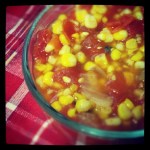
The bright colors and flavors make a great addition to any Mexican spread, an accompaniment for grilled summer steak, chicken breast or vegetables, or my personal favorite: scooped straight out of the jar with tortilla chips.

Canning is optional, and the salsa will keep up to three weeks without it — although as fast as I’ve watched my friends devour this stuff, I don’t think you’ll need to worry about it going bad. The flavors will be even better the day after it’s made.

Corn Salsa

From Put ’em Up, by Sherri Brooks Vinton

Yield: about 8 pints (Note: I cut the recipe in half)

12 ears corn, shucked

3 cups distilled white vinegar

1 c sugar

1 T ground cumin

1 T salt

5 lb tomatoes, diced

1-2 jalapenos, diced, seeds removed (leave the seeds for a spicy salsa)

1 green bell pepper, diced

1 large onion, diced

2 garlic gloves, mincd

1/2 c chopped fresh cilantro

Bring a large nonreactive stockpot of water to a boil. Add the corn and boil for 4 minutes. Drain. When the corn is cool enough to handle, stand the cobs on end and slice vertically to cut off the kernels, being careful not to cut into the cobs. (I use an electric knife.) Empty and wipe out the stockpot.

Combine the vinegar, sugar, cumin, and salt int he stockpot, and bring to a boil. Add tomatoes, jalapenos, bell pepper, onion, garlic, and corn kernels. Return to a boil. Reduce heat and simmer for 5 minutes, allowing flavors to blend. Stir in the cilantro and return to a boil. Remove from the heat.

If refrigerating, ladle into bowls or jars. Cool, cover and refrigerate for up to 3 weeks.

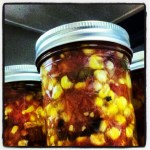
If canning, use boiling water method. Ladle into hot half-pint or pint canning jars, leaving 1/2 inch head space. Release trapped air. Wipe rims clean; center lids on jars on screw on jar bands. Process for 15 minutes. Turn off heat, remove canner lid, and let jars rest in water for 5 minutes. Remove jars and set aside for 24 hours. Check seals, then store in a cool, dark place for up to 1 year.